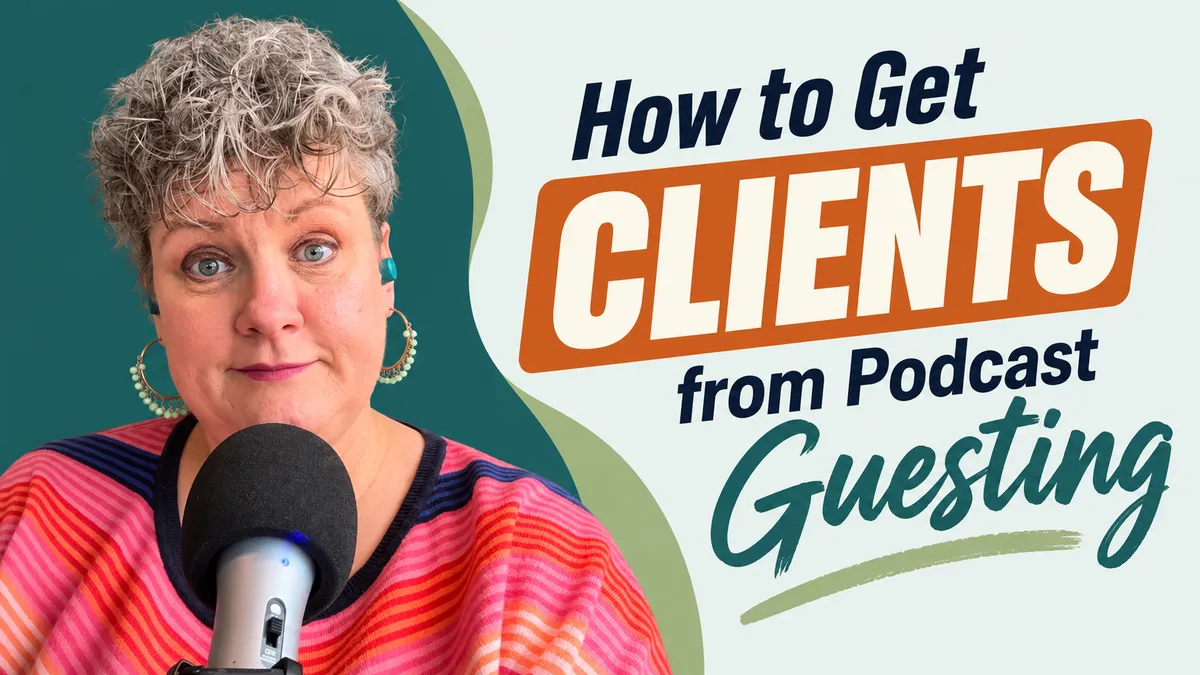
How to Get Clients From Podcast Guesting
Podcast guesting can help you get coaching clients, but simply showing up and having a good conversation isn't enough. You need a plan for moving listeners from someone else's audience into your own.
That means choosing podcasts that actually reach your people, giving listeners a valuable reason to stay connected with you, and then promoting the episode to your own audience once it goes live.
The podcast interview builds trust. Your lead magnet gives listeners a next step. Sharing the episode with your existing audience builds authority with people who may already be closer to hiring you than you realize.
Listen to the Episode
About This Episode
If you've been thinking about podcast guesting as a way to get more coaching clients, there is more to the strategy than finding a microphone and hoping someone invites you onto their show.
In this episode, Laura Hulleman breaks down how coaches can use podcast guesting as an actual client-generation strategy.
She starts with the practical details that make you a better guest, including sound quality, video setup, applications, and how to approach podcast hosts. Then she gets into the part that matters if your goal is getting paid: what happens to listeners after they hear you?
Laura explains why simply telling people to connect with you on LinkedIn isn't necessarily enough, why a valuable lead magnet can help move listeners into your audience, and why you absolutely need to share the interviews you've already done.
Because podcast guesting isn't just about getting in front of a new audience. A strong interview can also remind the people already following you exactly what you do, how you think, and why they might want to work with you.
What You'll Learn
How to become a better podcast guest without investing in expensive equipment
How to find and pursue more podcast guest opportunities
Why filling out a host's guest application can actually help you get a better episode
How to move podcast listeners from the host's audience into your own
Why promoting your guest appearances can help build authority with your existing audience
Questions This Episode Answers
How do you get coaching clients from being a podcast guest?
You need to give listeners somewhere useful to go after the interview.
The goal isn't simply to have 100 or 1,000 people hear you talk. If you're podcast guesting to grow your coaching business, you want some of those listeners to become part of your audience.
Laura recommends offering something valuable enough that the listener actually wants to take the next step. Instead of ending with a generic "connect with me on LinkedIn," think about a lead magnet, resource, workbook, course, or other useful next step directly related to the problem you discussed.
Once they opt in, they're no longer only part of the podcast host's audience. They're part of yours, too.
How can coaches get booked on more podcasts?
Start by telling people you're looking for podcast opportunities.
Look at the networking groups and communities you're already part of and let people know what you coach around and that you're available as a guest.
When a host has an application, fill it out completely. The information they're requesting—your bio, links, photo, background, and other details—helps them prepare and produce a stronger episode.
And if there's a podcast you particularly want to appear on, don't just submit the application and disappear. Follow up. Listen to the show. Mention an episode or question you genuinely appreciated. Give the host a reason to notice you among the other potential guests.
What should a coach offer listeners when guesting on a podcast?
Offer something the listener will want enough to take action even if they're listening while driving, walking, or working out.
Laura points out that many people aren't sitting at a desk while listening to podcasts. Your offer therefore needs to create enough curiosity and value that they remember it and come back to it.
A generic checklist may not be enough.
Think about the problem you help solve and what small but meaningful piece of that solution you can give away. A workbook, assessment, course, or another valuable resource can give listeners a compelling reason to join your audience instead of simply enjoying the interview and moving on.
Do I need to promote podcasts I've been a guest on?
Yes. Don't do all the work of becoming a guest and then hide the episode once it's published.
Sharing the interview isn't only about helping the host get more listeners. It builds your authority with your own audience.
Someone already following you may know you're a coach without fully understanding what you do. A longer podcast conversation gives them the opportunity to hear how you think, what you believe, and how you approach the problems you solve.
That can be especially valuable for people who have been quietly watching you but haven't taken the next step yet.
What equipment do I need to be a good podcast guest?
You don't need a fancy recording studio, but Laura strongly recommends using an actual microphone rather than relying on your earbuds for audio.
Sound quality matters. If people have trouble listening to you, your brilliant ideas aren't going to save the episode.
Laura also recommends thinking about headphones, your background, your camera angle, and how close you sit to the camera when video is being recorded. Even when the full video isn't published, the host may use clips on social media.
You don't need perfection. You do want to make it easy for the host to create something that sounds and looks good.
What Endotype Changes About This
Endotype isn't a primary focus of this episode. The bigger point is that podcast guesting needs to work as part of your business rather than becoming another marketing activity you do because someone told you that you should.
Before piling podcast interviews onto your calendar, know what you want the strategy to accomplish, where you're sending listeners, and what happens after they find you.
What Might Be Getting in the Way
Sometimes the hardest part of podcast guesting happens after the interview.
The episode comes out. The host gives you graphics and clips. And suddenly sharing it with your own audience feels vulnerable.
What if your sister listens? Your husband? Your daughter? What if people you know hear you talking about your work?
Laura's point isn't that you should shame yourself into posting anyway. It's that if you aren't comfortable enough with your work to let the people already around you hear you talk about it, that's something worth addressing.
Otherwise, you can spend time finding podcasts, applying, preparing, recording, and waiting for publication—and then skip one of the most valuable parts of the strategy.
Your Next Action Step
Spend 30 minutes creating your podcast guesting next step.
Write down the ONE resource you would invite a podcast listener to get after hearing you speak.
Ask yourself: What could I give someone that directly connects to the problem I talk about on podcasts and is valuable enough that they would actually remember to go get it?
Don't build the whole thing today.
For now, decide what it is, who it's for, and the specific reason someone would want it.
Want Help Taking the Next Step?
If you want podcast guesting to become an intentional part of how you grow your coaching business, Laura's 90-minute Clarity, Strategy, Impact (CSI) Call is designed for exactly this kind of focused strategy work.
You can use the call to clarify where to find podcasts with your audience, develop the lead generator you'll use to convert listeners, figure out how you'll promote your appearances, and decide how to repurpose those interviews into evergreen content.
Book a CSI call now, and we can have those podcast working for you in no time
You can also take the Endotype Formula Quiz to learn more about how you're naturally wired to build your business:
About Laura Hulleman
Laura Hulleman is the founder and creator of the Endotype Formula and host of Getting Coaches Paid. She helps coaches understand themselves, their clients, and the way they naturally build their businesses so they can create an income and impact they are proud of.
Episode Transcript
Hello and welcome to this episode of the podcast.
Today we are talking about podcasts: how you, as a coach, can be a great podcast guest, get booked on more podcasts, and make podcast guesting work for you.
A lot of coaches would either like to start their own podcast or be guests on podcasts.
Now, here's my personal opinion. I think you need to be a guest on a lot of podcasts before you build one of your own. I think by doing that, being a consumer of many coaching podcasts, and also being a guest, it's going to give you a lot of options for your own podcast.
So today we're going to dial in and specifically talk about guesting on a podcast.
First of all, there are some logistical things that, if you're going to make being a podcast guest part of your strategy, you need to think about.
The first one: microphone.
Hello, friends. You need to be using a microphone. Not your earbuds. Not a Bluetooth or wired earbud if you are going to make a point of podcasting.
You do not have to make a large investment. This microphone that I use each and every week cost me about $30 or $36, included the stand, and plugs right into my computer.
Maybe you eventually want to have a podcast with a big recording studio and a fancy microphone. Great. That's all great.
But we're talking about getting started as a podcast guest.
The number one reason people will shut off your podcast and your podcast will get fewer views or listens is sound quality. You might be so smart, but if your sound quality stinks, people will shut off your podcast episode.
So invest in a microphone.
The second thing that I encourage you to do is, if you are guesting on a podcast—and you'll see every time I have a guest on my podcast, if I'm wearing headphones in the video clips, it means I have a guest episode—the reason is because there's no feedback.
So either get Bluetooth earbuds for your ears and a microphone for your sound, or you can use wired earbuds for your ears and a microphone for your sound.
Now, I record on Zoom. I have also been a guest on Descript. Every place that I've been a guest, I get to choose my own microphone and my own speakers.
Those are two options you can choose, and your sound quality just dramatically improved.
The next thing is I need you to think about whether or not there's a video component.
For myself, I don't publish my guest episodes with video, but I do record the video and then we use that video as clips.
Not only should you look the way you want to look—which doesn't mean fully makeuped, but it might mean maybe not in your jammies—I also want you to think about the space around you.
Does your background look good? Or are we just going to do a blur?
Blur background's not that great.
I also want you to think about camera angle and camera closeness.
So many of my guests are doing podcasts with this much of their face in the middle. I will tell you that when we crop to be able to drop it on social media, we crop from here to here.
They become the giant Wizard of Oz, the great face in your screen.
Sit back a little.
Sit back a little away from your camera. Have a little space above your head.
And not the other thing that I see all the time, where there's way too much space above your head.
Have a little space above your head and be able to see a portion of your torso.
Because now, when it crops, it crops me like this, not like this.
Does that make sense?
It's something you don't think about until you start running a podcast and you start noticing how things clip.
Okay. How do you get more podcast gigs?
Put it out there, my friend.
What groups are you a part of right now? What networking groups are you a part of where you can say, "Hey, I'm looking to guest on more podcasts. I talk about this subject," or, "I'm this type of coach"?
Don't have a completely prepared script.
I've had some people who I met through a podcasting group who were trained that they should come into a podcast with a specific title in mind.
"Here, I will give you the title of my podcast."
That's weird.
How about I ask the questions as the interviewer and then create the title from there?
Now, I know there are some podcasts out there where they love for you to give them three questions to be able to ask. They really want you to be able to get asked the questions you want.
That's not the way I run my podcast. I do more of an organic interview style.
But I do have a form and an application.
Fill them out, friends.
Fill them out fully and completely.
There are some people who are like, "I don't want to fill it out. I just want to be on podcasts where I don't have to fill it out."
Podcasts that don't have you fill out some paperwork ahead of time are not well produced. Guarantee.
When I have you fill out that form ahead of time, you're giving me your links to put in the show notes. You're giving me a biography. You're giving me an update of who you are and what you're about so that I can prepare as an interviewer. You're giving me your picture.
You're giving me everything that I need so that your episode is well produced.
It blows my mind.
There are some Facebook groups specifically about being a podcast guest. I will drop in there, "Hey, I'm looking for coaches to be on my podcast."
They will say, "Pick me! Pick me!"
I send them a link to the form to fill out their information, and I think, "Oh, they'd be a great guest."
And then I don't see their form.
I don't see their form.
I follow up and they say, "Oh, you wanted me to fill out a form? I'm not going to do it. That's not the way I do things."
Cool.
You don't get to be on my podcast, but cool.
Fill out the forms.
It's a way to gather all the information about you so that we can produce a great episode.
I have never, and I will probably never, use a speaker one-sheet to pick my podcast guests. I don't.
Maybe if you have some kind of agent who's booking for you. There are agencies out there that will do that.
I will tell you this, though: make sure you vet your agency.
Make sure they're using an email directly back to you, because I get people all the time in my inbox pitching me.
"Here's somebody who sold the most tires in San Diego back in 1989. We think they'd be great on your podcast."
Have you listened to my podcast?
That has nothing to do with anything that I talk about.
So if you're hiring an agency and they're supposed to do ten pitches a week, but they're just pitching any random podcast, you are wasting your money.
It doesn't take a lot.
Go into the Facebook groups. Fill out the forms.
And just like back in the day when we had to apply for a job, if you really want to be on that podcast, don't just fill out the form and then forget about it.
Reach out and say, "I hope you got my form. I love this episode of your podcast. Here's the question that I really loved that you asked."
A little flattery will get you a long way when it comes to podcast guesting because it draws the host's attention to you as a guest.
Now, those are a couple of logistics that are going to make sure your podcast gets played because you have good audio and that you get on more podcasts.
But here's the third thing.
How do you prepare yourself to make sure that you're getting the most from your podcast episode?
I'm assuming you are podcast guesting because you would like clients.
If I am wrong, then ignore this next bit of advice.
The reason you are podcasting is so that this audience here can come and be your audience.
If the podcast host has 100 people or 200 people or 1,000 people who listen to their podcast regularly, you're trying to get ten of them to come and be in your audience.
The way you do that is by bringing them into your audience.
Where does your audience live?
See, if you have an offer like, "Connect with me on LinkedIn," you're not going to get ten people out of their 100 to come over and connect with you on LinkedIn.
If you have a lead magnet, you can pull part of their audience over into your audience.
Now, the lead magnet has to be good.
The lead magnet has to be good.
There has to be value to that listener.
The majority of people listen to podcasts when they're not in front of their desk. They listen while they're at the gym, while they're in the car, or while they're walking.
"I have a lead magnet and it's a list of seven things that you can do so that you don't feel stuck. Like deep breathing."
Okay, thanks.
No.
"I put together a workbook that allows people to work through the reasons they specifically have anxieties and then three solutions to be able to apply for each type of anxiety that that person has."
"What type of anxiety do I have?" the listener thinks. "I would like to know that."
See, it's a positioning thing.
For myself, I have found that when I am able to give away a significantly valued gift, people respond.
So I'll give away my course sometimes on podcasts when I guest, and I let people know, "This course normally costs this much. For the first 20 people who use this code, they'll get it for free because that's how much I believe that coaches need to learn why they're not getting clients and what they need to say to get clients."
All of a sudden, people want that course and they join my audience.
They sign up for that free lead magnet, and now they're on my email list and I get to market to them.
The other reason you're going to be on podcasts—the other way you're going to get clients from being on podcasts—is by using your own audience.
It surprises me how many people podcast guest, and you go through the application process, you go through getting ready for the podcast that day, you show up, you do the interview, and that podcast person says, "Here's the episode I've produced. Here's all the marketing assets that I've produced for you. Let's share it together."
And people don't share it.
Because sharing it with your audience—maybe your friends are on your social media, maybe your family is on your social media—it can feel a little vulnerable.
"What if my sister hears this? What will she think?"
"What if my husband listens? What will he think?"
"What if my daughter hears?"
If you're not comfortable and confident in the work that you do yet, that is a place you need to start working before you podcast guest.
Don't waste your time podcast guesting and then not share the episode.
Share the episode.
What it does is it raises your authority and your expertise.
In your audience right now, you have five, six, seven people who are ready to start working with you.
But see, they forgot about you.
They forgot about you because they don't check their email, or maybe they gave you that junk-folder email. So when you send out the emails, they're not seeing them.
They forgot because they see you on social media, but they don't quite understand fully what you're about.
But when they listen to a long-form podcast interview, they're like, "Oh, that's what she's about. I want to work with her."
If you are not sharing, you are missing half the reason to even do the podcast.
I watch it in the numbers all the time.
As a podcast host, I can see the numbers of downloads and the numbers of listeners.
It might surprise you to know that even when we had fewer than 100 downloads every month, we were still in the top 10 of all podcasts.
It doesn't take a lot of downloads to put you in the top 10, even the top 5 to 7 percent of podcasts.
But I can tell when it's just me doing the promotion as opposed to me and the guest doing the promotion.
The numbers don't lie.
The listenership goes up dramatically.
Now, on a completely different day we can talk about—or if you're actually going to use podcasting as a strategy, maybe what we need to do is one of my new CSI calls.
Clarity, Strategy, Impact calls specifically around how to be a podcast guest and how to get more podcast guest opportunities.
We could develop a lead generator for you, with you.
We could set you up to know where to find podcasts specifically that have your audience.
How are you going to convert and use them?
How do you take that podcast and make it evergreen, something that's always working for you, or repurpose it into other pieces of content?
All of those things are very, very possible.
I'm not going to get into all of them on today's episode of the podcast, though.
For that, we need to have some one-on-one time.
If you're interested in a CSI call, it's a 90-minute Clarity, Strategy, and Impact call.
We get you super clear on your next moves, and you can use it to either be very specific about something like a podcast, or we can use it to be more generalized.
How do I get my business momentum going forward?
Where am I confusing my clients?
Where is my branding not working and a little bit yucky?
All of that.
Those things, auditing your marketing, auditing your website, are included in a CSI call.
We'll talk to you real soon.


