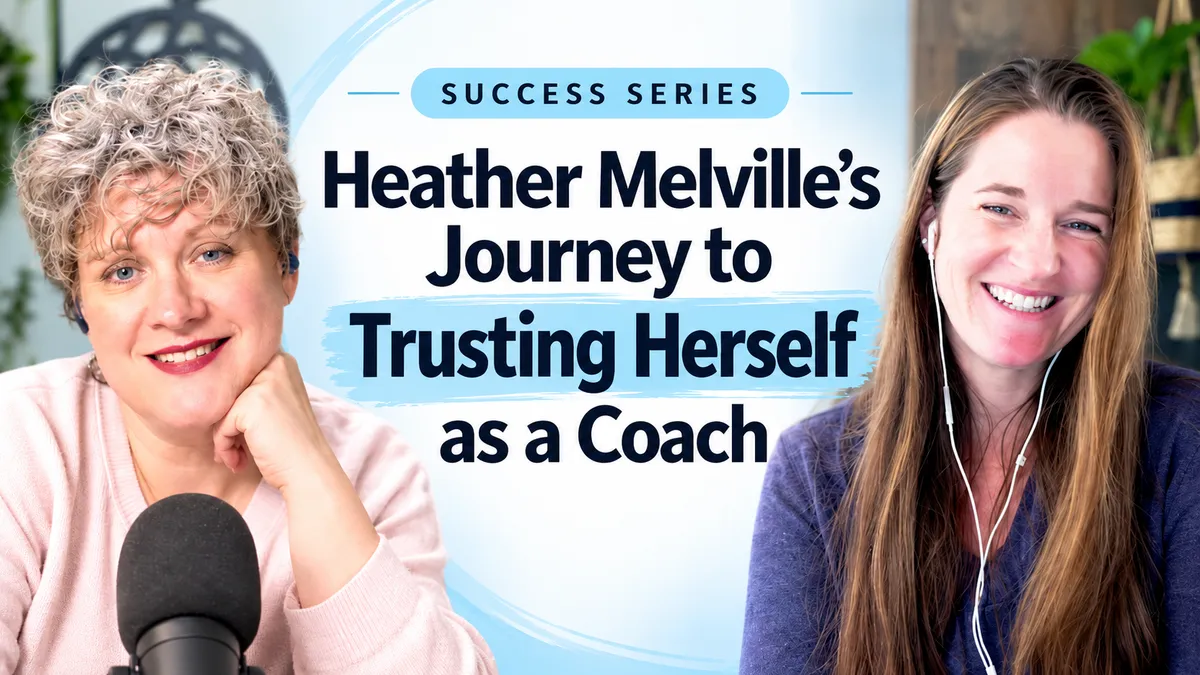
Heather Melville's Journey to Trusting Herself as a Coach
You can be an effective coach and still be learning to trust your own judgment. Heather Melville's journey illustrates that those two things can be true at the same time. What helps is shifting your attention from judging whether you're good enough to understanding what your client actually needs.
It also matters that you build and market your coaching business in ways that fit how you naturally work. In this episode, Laura and Heather connect relationship coaching, Heather's Counselor Endotype, and the language potential clients use when they're ready for help.
Listen to the Episode
About This Episode
Heather Melville works with women who have experienced unhealthy or toxic relationships and want to trust themselves again. In this Success Series conversation, Laura Hulleman invites Heather to share how her own story influenced her decision to become a relationship coach, how she approaches her clients, and why learning to trust her choices continues to matter in her business.
The two explore Heather's Counselor Endotype and the difference between helping other people feel safe and connected and understanding her own need for belonging. They also discuss a challenge most coaches recognize: second-guessing whether you can deliver for a client, especially when the client is paying for your work.
Later in the conversation, Heather talks about how the topic of a workshop affects whether her audience responds. Instead of announcing the ideal transformation in broad language, she considers what women already recognize as an urgent problem. It's a useful distinction for coaches who are getting attention but not enough clients. The takeaway is not to copy another coach's strategy. It's to notice your natural strengths, communicate in the language your clients use, and focus on the actual person you're helping.
What You'll Learn
How Heather explains who she helps and the relationship patterns her clients want to change.
Why a coach's own story can inform their work without becoming the client's story.
What Heather's Counselor Endotype reveals about connection and belonging.
How self-doubt can distract a coach from the client in front of her.
Why a workshop title should name a problem people already recognize.
Questions This Episode Answers
HOW DO I KNOW WHETHER I'M GOOD ENOUGH TO COACH CLIENTS?
Heather describes feeling more effective when she stops measuring her performance in real time and pays attention to the person she's helping. Confidence does not have to arrive before you can be useful. Focus on listening, noticing what the client actually says, and choosing the next appropriate coaching question instead of trying to prove you're doing everything perfectly.
HOW DOES MY PERSONAL STORY RELATE TO MY COACHING BUSINESS?
Heather connects her own experience of an unhealthy relationship to the work she now does with women seeking safer, healthier love. Her experience is not a substitute for listening to each client. It helps explain why she cares about the work and which patterns she pays attention to. A coach can let personal experience inform a specialty without assuming every client has the same journey.
WHAT CAN AN ENDOTYPE REVEAL ABOUT HOW I COACH?
Laura explores Heather's Counselor Endotype as a way to understand her natural orientation toward people, connection and belonging. Heather recognizes how that language fits parts of her experience. The point is not to squeeze every coach into identical business advice: noticing your natural tendencies can help you use your strengths more deliberately and recognize when a personal need is coloring a business decision.
WHY AREN'T PEOPLE SIGNING UP FOR MY WORKSHOPS?
In the episode, Heather talks about the difference between an aspirational workshop concept and a specific problem her potential clients are already trying to solve. A title describing the future you want for someone may not attract as much interest as one naming what keeps that person awake now. Coaches can use that difference to make their invitations clearer, without changing the substance of their work.
WHAT ENDOTYPE CHANGES ABOUT THIS
Laura identifies Heather as a Counselor Endotype and explores the significance of connection and belonging. That adds a practical business question: are you using your natural strengths to help clients, or asking your business to fill a personal need? This episode shows why understanding the distinction matters.
WHAT MIGHT BE GETTING IN THE WAY
Heather and Laura discuss self-doubt, second-guessing and pressure to follow another coach's way of doing business. Those responses may feel protective, but can draw attention away from clients and the clear message prospective clients need.
YOUR NEXT ACTION STEP
In 20 minutes, rewrite the title of one workshop, service or social post using the exact problem your ideal client would say out loud today. Keep the content the same; change only the invitation.
Want Help Taking the Next Step?
If explaining what you do is harder than doing the coaching, explore the MasterClass in Your Coaching Business. https://endotypeformula.com/masterclass
Curious how you naturally work? Take the Endotype Formula Quiz: https://www.endotype.com
About Heather Melville
Heather Melville is a relationship coach and founder of Healthy Relationships. She works with women whose experiences of toxic relationships have affected their trust in love, in other people, and in themselves. Her coaching focuses on recognizing repeating patterns, reconnecting with their own decisions, and moving toward relationships that feel both safe and passionate. In this interview she connects her work with her personal experience and her evolving ability to trust herself in her coaching business.
Website: https://healthyrelationships.info
LinkedIn: https://www.linkedin.com/in/heathermelville756/
LISTEN NEXT
Suggested related episode: How to Make Better Decisions in Your Coaching Business
ABOUT LAURA HULLEMAN
Laura Hulleman is the founder and creator of the Endotype Formula and host of Getting Coaches Paid. She helps coaches understand themselves, their clients, and the way they naturally build their businesses so they can create an income and impact they are proud of.
Episode Transcript
Heather Melville’s Journey to Trusting Herself as a Coach
Laura Hulleman: Welcome to this week's episode of the Getting Coaches Paid podcast. I'm your host, Laura Hulleman. And today, we are interviewing a coach. A coach doing great things out in her space, a coach that I've had the pleasure of being able to work with, and to network with for a number of years. It's my good friend Heather Melville. Heather, welcome to the show.
Heather Melville: Thank you for having me, I appreciate it.
Laura Hulleman: Yeah So, why don't you start by telling us a little bit about what you do, who you do it for?
Heather Melville: So, I have started Healthy Relationships. I help women who have experienced a bad, toxic relationship that has really destroyed their trust in men, in love, and most importantly, themselves. I help them break those cycles that have them repeating the same painful relationships Over and over again, causing them to only get over… only get excited over men who are really not good for them, making them feel like they're only attracted to the bad boy. And then they believe that they're just unlovable, they've got a broken picker, or they have so much trauma that they could never be in a healthy relationship.
And after working with me, we are able to kind of get back to trusting themselves again, trusting their decisions, really taking control of what it feels like to be in their body and enjoy their body, and taking control of their relationships, their life, and finding that safe But passionate love that they really, really want. What they've been looking for this whole time.
Laura Hulleman: Yeah. That is amazing. So, a few questions that I have about that. What kind of made you go into… This arena, start your business, go into the arena of relationship coaching.
Heather Melville: Well… gosh, I could write a book about this. Just knowing that I was doing something that I enjoy, but am not passionate about. So previously, I was an electrical engineer, and actually, I do a little bit of part-time consulting now, but I'm not fully a logical person. I'm also a creative person, and so I knew something was not quite right. I knew I wasn't doing what I was supposed to be doing. And then I was like, okay, so what is it I'm supposed to be doing? What, you know, I know that I love to talk, I love to listen, I love to hear people's lives, I love to help them in any way I can. And so I was like, okay, then what about something that's consulting, coaching, counseling, whatever that is, and helping people? And then I was like, okay, well, what do I want to talk about? Well.
I kind of have this, like, utopian society idea, and I look around at, like, all of my friends, my family, I look at their relationships, and I just wonder what we would all be like if we had healthy, fulfilling relationships that just made us light up that made us realize that we can handle whatever comes our way, whatever life throws at us, it's fine, because we've got the relationship to help us be our highest potential, somebody to support us when we're not feeling the best, you know, someone there to witness our life. Like, how would we all show up? What would the world look like if we were all, like, in this space?
You know, there'd be no war, and so… that was where I was like, okay, I want to focus on relationships, and then… and actually, I just had this kind of breakthrough… breakthrough this morning that part of my own healing journey from a toxic relationship that I experienced for 8 years. is actually helping others do it, and it's crazy, because I'm sitting here, like, writing these newsletters, or doing these workshops, and like, let me help you! At the same time, it helps me reflect back of, like, oh… I was triggered there, or oh, that's a pattern I've been having! Oh, no wonder! You know, like, just so it's… it's been a breakthrough for me as well.
But yeah, I just… I realized that there are so many of us experiencing toxic relationships, and… And if we don't stop the pattern, if we don't break out of the patterns that keep us stuck. and have us looking at these people that we think are good for us and are not, and ignoring a lot of things, and going into a relationship when we don't even love ourselves fully. We're just gonna repeat the same pattern, and then we're gonna just spread it to every generation. It's just gonna keep on going. that was one big thought that I had when I was breaking out of my previous relationship, is like, I'm gonna carry this on into the next generation. I'm gonna be part of their generational trauma, and I want to stop it here for me, and I want to stop it for others.
Laura Hulleman: Oh, that's hot. That's real hot. I also, right, like, I had already procreated, and had two kids with the relationship that I left, because it had become toxic, and I didn't… I don't think that I ever… I knew it wasn't healthy. I knew it was crazy-making, but I don't know that I ever really considered it toxic for me, in the moment. Right? In the moment, it was just like, man, if I could just… How can I use the right words? That'll make it make sense for him, and make him see… his part here, right?
Heather Melville: responsibility?
Laura Hulleman: here, the changes he needs to make here. And… and yeah, I don't… I don't think I considered it toxic. In fact, I didn't understand for myself that the feeling that I was in my body, you know, you talked about in your introduction there, you know, women learning to be in their body and enjoying their body. I was really, and I'm gonna use quotation marks for those of you who are listening, right, stressed. I called it that all the time. And I had been stressed because of just the… the… situation at home, and the mentality that I was running into, and the growth that I was experiencing, because I was… I already had a coach, I was going to personal growth workshops, and I was figuring out my life. And meanwhile, there was this, you know, this other guy that… he was attending a lot of the same coaching workshops.
He had coaches and had a bro squad of accountability. And it just didn't seem to be having the same effect. So I was…
Heather Melville: Whoa!
Laura Hulleman: for a really long time. But I don't know that I ever considered it toxic, and I never knew… that the experience I was having in my body, and the experience my little children were having in their body, was called fear. I thought I was stressed, and it wasn't until we separated and we were in the absence of each other for… about 4 months. And then tried to work on the relationship. He came in, started throwing one of his little hissy fits, and I looked over at my kids. And they were afraid. That was fear I saw in their face. And then I felt my body, and I could feel the old stress. Just creeping into my shoulders and body and nervous system, and everything was tight. And I realized it was fear. And dude, I was out that day. Like, that was it.
You know, there was a whole lot of logistics that needed to take place after that, but, I'm… I had no idea. I didn't have the right words, even. So…
Heather Melville: Right.
Laura Hulleman: I've… I've been there with you, friend.
Heather Melville: Well, and I like that you say that, too, because I didn't… I didn't identify my relationship as toxic till… till we started using this vernacular way after I had already left. And, I mean, you know, I really look back and I'm like, whoa, Toxic is just barely tipping the iceberg over there, you know? Jeez. And you had mentioned this to me before about, like, identifying that you called it stress, but reality, it was some fear. And I had written that down a while back, and I was like, what did I used to call it? I used to call it desperation. just desperate for somebody to be there. And the fear was I didn't think I could handle life on my own.
Because as you were talking, and you said, you mentioned the four-month break, and I was like, oh… I did that when I moved to Germany for 6 months, and he stayed behind, and I started to see the patterns, I started to feel better about myself, I started to feel resilient and courageous, that I could handle things. And then when… when he came back, it was just like. these patterns, but I did fall back into thinking that I couldn't handle it. For another year, we stayed. And then I moved to college… I moved away for a second bachelor's degree, and I, again, started to see the patterns again, and I was like, well, wait a minute, I've already proven that I can I can handle things, and you know what?
Honestly, I'd rather handle them by myself, because now I don't have to sit here and run… run this by somebody to sit here and have him, like, trash on my ideas, or trash on me saying that I couldn't make it, or I had low self-esteem. So, I just… I love that you say that, too, as far as not knowing to identify as toxic, and then what did you really call it? What was the fear that you were really calling it?
Laura Hulleman: Well, and, you know, your… your story totally makes sense in conjunction with your endotype as the anxious gonadal counselor, that we just call counselor. As you know, because we've worked together, your young child connects with a desire and a yearning for belonging. So wondering… and then your parent piece of you questions the worth and the value. Can I really do this? Am I strong? Enough. Enough is, like, the key word of that… that questioning, protective, parental voice that operates in your mind. Is it enough? Am I gonna be able to do enough? Will I have enough money? Will I… right? Whatever it is, enough, enough, enough. and your young child just wanted a community to belong to, I wonder if… And, and this, right? we'll see.
I'd love to explore here for a second, but I wonder if between that… during that last year, was there any difference that happened in terms of your connection? Like, building an alternative community, or reconnecting with some grounded community that allowed you to be able to say. I don't need to belong over here to this toxic dude anymore.
Heather Melville: Yeah, actually, you're right, now I'm thinking about it, because when I came back from Germany, I realized that I, like, made it a point that my two best friends had Wednesday off, so I would make sure I had Wednesday off, and I would make it a point every Wednesday to hang out with them. and be with them. And of course, there came a lot of strife, because somebody was either jealous or saw that it was beneficial for me, that I might be moving away from them, and stuff like that. And it's funny, you… I was gonna comment as well that when you said that you saw your children's fear, and then you were out that day. for me, it was… he had said something in, and I might be a little graphic here, he had said something in bed that I had always fantasized about.
But when he said it, my skin crawled. I was like, no, never. I don't feel safe, I don't trust that, I… I am not turned on, I am grossed out. And… it was like… that was the light bulb. It's like, I don't want to live feeling grossed out. I don't want to… I'm a sexual person, and that's something I had to realize, and that's something that I also kind of focus on with clients as well, because when you are resentful, when you're in a toxic relationship, when you don't feel safe, your body shuts down, or it starts doing some crazy things, like… And to go on in life and not enjoy sex, and not enjoy your sex drive, and not experience this, it just sounded so horrible. I was like, I don't want to spend life like that. I want to enjoy, you know?
Even this part of me that is kind of taboo to talk about, you know?
Laura Hulleman: Now, we can.
Heather Melville: Let's talk about.
Laura Hulleman: What's sex babe? No, let's… Breaking a song, breaking a song will get demonetized. No, I don't even know what that means. You know, it's interesting, because some of your clients, knowing your superpowers, because you and I have also talked about your coaching superpowers. Some of your clients are going to be experiencing Because for you, right, that your endotype, your young child, connects to that belonging piece, which is that root chakra, which is, right, our sex drive, sexual organs, period, all of those things. For your clients, there are parts of them that are gonna need, or craving protection and craving some coaching might be around their heart space, their thymus gland. Which is a immune system gland.
So for a lot of people who are struggling with love and heart connection, one of the great things that you help people with, or with, intuition, which is kind of this third eye space, this can cause a lot of migraine headaches, it can cause weight gain, right? The thymo… or the… the… I said it, and now it's gone. Gary Glant.
Heather Melville: Oh, but.
Laura Hulleman: The pituitary is up here, and that's your, that's your hero, but then here, this is your zone of genius and the thymus gland. So, right, headaches, weight gain, pituitary issues, or just chronically getting sick, their immune system is… or overactive immune systems, right? Either or, with autoimmune issues. Those are some of the symptoms. Wow, that's… So your face just did a thing!
Heather Melville: Well, because, okay, and the other thing I always talk about, too, because this really makes sense, and I… I always stress, and because I, you know, I'm coming in, we're talking about relationships, we're talking about yourself, but you're a big picture, you're an overall picture. finance, your mental, your emotional, your physical, and I'm a big proportion of physical, and it's funny because, when I was in that relationship, I was overweight by 20, 30 pounds. Even though I'm sitting here running, like, 3 miles, I could not shed the weight For nothing.
I couldn't diet for nothing, and let's be honest, I do have a sweet tooth, so I'm sure I could have dieted more, but I don't think it would have changed, because when you're in that constant stress, your cortisol is through the roof, and that's inhibiting any type of weight loss or fat burning, because your body's like, whoa, whoa, whoa, we gotta stay like this, you know, let's keep us safe. So it's so funny, and then also. because I was so concerned, I was like, I am… I am working out 3 days a week. I'm… I mean, I'm not sitting here eating bird food, but I'm eating rabbit food, I'm eating salads every day, what's going on? I can't shed a pound. And so I had blood tests working. And, because also, what is it, hyperthyroidism? Thyroid issues, they run in the family. I don't try to, subscribe to that.
I think, you know, nature is the gun and loads it, but, you know, what you do with it is what fires it. Yeah. So, like, you know, just because it's in my background doesn't mean I for sure have to have it, you know?
Heather Melville: But, so I went to get it tested, and they were like, your white blood cell count is, like, through the roof, and I'm like. Oh, I was in that over-hyper-immune system. trying to find something off, so it really makes sense when you said that. I was like, bling!
Laura Hulleman: Yep, absolutely. And even thyroid challenges, so thyroid connects in our system to your voice.
Heather Melville: Right, right.
Laura Hulleman: And that is on your protective side, so not using that voice, not advocating your boundaries, not saying the things that need to be said, and then Believing them yourself. Right? Like, I found myself in that situation where I'd be like, things have to change. And then I wouldn't make them change. I wouldn't make the change, because the only change left in my situation was a separation, and I didn't… I was pretty sure if we separated, we were gonna end up divorced. I was really… resistant. I was very resistant to that, right? We had kids, we had made a commitment, I had all kinds of feelings about it. And so, yes, my thyroid was definitely slowing down significantly, even though I don't have thyroid on my protective side. It's one of my superpowers, is connecting with, right, helping people to be able to say things.
I'm pretty vocal myself, as anybody who's listened to the podcast has ever realized. But, at that point, I wasn't honoring. that voice of myself. So, it was affecting my body, for sure. And that's, I mean, that's what the endotype formula shows us, is… We are an interconnected being, like you said. We're the spiritual pieces, we're the internal psychological pieces, we are the, you know, the energy and the body, and it all connects in a predictable way. So, yeah, that's great that you're helping people with that. I had another question that I was thinking. How… Here… so, when… when you were talking about what you do, you talked about, people worrying that they had a broken picker, and people being attracted to the bad boys. For real. That's a real fear.
Heather Melville: Right.
Laura Hulleman: That's… even though I haven't gone from that relationship into… I knew I needed time for myself and for healing first. So I took that time. But any additional opportunity that I have had to, connect and, you know, see if maybe a little something's there. I'm not gonna lie, my… The pickings are slim, so that's a whole thing. I'm a unique and special kind of woman, so it's gonna need a unique and special kind of man.
Heather Melville: Yeah.
Laura Hulleman: But I also, for the first few interested parties that showed up, They were knuckleheads. For reals, right? They were pretty big knuckleheads. And that was scary to me. Internally. I don't know that I've ever expressed this to anybody else, but it was really scary, because it… it reinforces that idea. That I may only attract knuckleheads.
Heather Melville: Well, and then, too, it's like… it's almost like you can't see anybody who's not a knucklehead, because your body's already used to this kind of love. Like, anything that's beyond that, that's even… has any depth that is actually healthy for you, is not gonna feel right. You're gonna be like, oh, that's… are you… you're too much, you're too much, you're way too desperate for me, or you're showing me a mirror of the things I need to work on, and I'm not ready to look. But, like, so that's where you're drawn to the necklads, because it's what you know. it's comfortable, even if it is painful, it is still comfortable. So it's so crazy that, yeah, and you do, you get scared.
I definitely got scared, but I kind of… when I came out of this. it was… so liberating, and like… like you said, that fear was there, but then the day I broke up, it was just like this elephant had just taken its foot off me.
Laura Hulleman: Hmm.
Heather Melville: Oh, for sure.
Laura Hulleman: Sure.
Heather Melville: I was like, you know, the sky is the limit, and if I want to be alone for the rest of my life, that is my choice. And… and I… going into another relationship, I was like, am I gonna not see these red flags? Am I gonna ignore them again? Am I going to be in this space where I feel so desperate for somebody else to validate me, to make me feel good about myself? that I'm just gonna completely ignore and settle for, you know, the next person that looks like a man! And I had kind of made a promise to myself that, like… well, not even, it just was set in me that I'm not gonna sacrifice my peace now. Or my ability to make decisions, to do what I want to do in my life. for anything less than I am deserving of.
And I know I am not deserving of what I've had in the past. I did not do anything wrong to have somebody, you know, hit me, or point a gun at me, or any of that. I didn't do anything. I never… I never stabbed somebody, so why would somebody point a gun at me? Like… So, I'm… and it's coming back to that, it's really coming back to that, but yeah, you're right, that's the big thing, is like, am I gonna pick the wrong person again? Or, I'm only attracted to this person because, you know, like, I think that you're… I'm only attracted to these kind of people, I'm only attracted to knuckleheads, and therefore, those are the only people that are attracted to me.
Laura Hulleman: Yeah, I was… I was real clear I wasn't attracted to them. I was like, oh, - nope. And that was one of the great things, was being able to move on from… right? Like, when it became very obvious that, oh, you are a knucklehead.
Heather Melville: And you lose attraction to them almost immediately when you…
Laura Hulleman: And I was like, nope, this, right? Like, this really isn't gonna work. Right. Bless your heart. Like, I'm sure there is somebody that'll work for you. It's not me. And I found a great way to break up with them, I'd be like, let me tell you all the ways I'm going to annoy you. And then I would just tell them about my expectations, and I would tell them about my personality, and I would tell them about my, like, how we're gonna interact with each other, and they were like, you're right, you're gonna annoy me. And I was like, yeah, exactly. So we're… we can just be done now. Right? No, no shade, it's just, you know, like, you… you have a room full of toys that you have invested most of your life savings in, and I'm not going to own that in my house, but thank you for trying.
You know, like…
Heather Melville: Well, I've had that experience, too. I had an old friend in high school kind of look… we reconnected after I had broken up with my ex, and we went to Disneyland together, and he threw a tantrum. Like, I've never seen a man in his 30s throw a tantrum before, and it was… completely unattractive, and I was like, God, I need to get away. I'm so sorry, but I don't… this is not attractive. I'm not going to be your mother, I'm sorry. I'm not looking for that.
Laura Hulleman: Exactly! Exactly. I had one gentleman, he may or may not have been the same collector of toys. Who… who didn't live in the same state. We had… we had been texting. Because we had met online. And he was like, I'm gonna get… I'm gonna jump on an airplane, and come… come up to your area. And I was like, I don't think so. Like, why… why? Why? Like, do you… are you really… because he was like, if I… if I came to visit… if I came to your area, would you show me around? And I was like, mmm… Are you coming because you really want to see Wisconsin, or are you coming because you want to see me? And he's like, both. Okay, don't. Wha- why… Are… that's weird. And he was like, what do you mean? And I was like, we've never talked on the phone.
Heather Melville: Yeah.
Laura Hulleman: And he was like, oh, that's hard for me.
Heather Melville: Mmm, but I'm not inviting a stranger into my house or near my area if I've never even heard your voice before.
Laura Hulleman: And, right, and, and… There was this… there was a thing that was churning inside of me in this interaction. Fortunately, I had a great therapist at the time, and I was like, I can't figure this out, let me just, like, talk it out, talk it out. And it was… so I have… one of my cravings, connected to my protective parent side of me, is a craving for significance. And when he was, like, Talking on the phone would be hard for me. You might have to give… you might have to be patient with me and give me some time. Nope. If you can't talk on the phone for me. For an opportunity to get to know me? Nope. And, also, I'm not gonna tell you that via text. I'll tell you that when you call.
Heather Melville: So…
Laura Hulleman: I never told him that. Because I was like, okay, call when you're ready. And the phone call was going to be… thank you very much for participating, but I can tell already that this isn't gonna work for me, because, right, if, you know, I need a man who just, like, leans into what I'm asking for, and the thing that I was asking for was a phone call. Anyways, it was a whole… I had a speech. Prepared, just in case he called. But I was like, I am not gonna tell him any of this until he calls. You know why? Because I deserve the phone call.
Heather Melville: Mmm, that's good. Mic drop right there.
Laura Hulleman: Yeah! And so, right, it's figuring out those things, and just… I love the idea that you're getting them into the bodies, because, right, that's where it was happening for me, was, like, this, like… there's something weird happening with this interaction that's way more than a phone call, and I had to sort through it.
Heather Melville: And I think that's important, too, to drop in the body, because also, you know, they talk about the difference between chemistry and compatibility, and, like.
Laura Hulleman: Yeah.
Heather Melville: how chemistry we sometimes feel, is like this nervous energy, but not all the time. Maybe that nervous energy is that your nervous system is like, I don't feel safe. But we're confusing it with, oh, we must be attracted, we must be chemically aligned, and all of that, and it's like, we won't know the differentiation if we're distant from the body. Because you can tell the difference between, I feel excited because my heart is like the Grinch and grown three times the size when I'm around you, or I have knots in my stomach, and it makes me feel a little giggly and nervous, and it's like, maybe I'm not feeling safe.
Laura Hulleman: Yes.
Heather Melville: don't trust you.
Laura Hulleman: Yeah. For me, a lot of learning what it feels like in my body is actually in observing other couples who I respect and who are doing it right. And, there was this cute little couple, she loves to talk, and he's got stuff to do. And, you know, and she was… and so we were at this, like, social, event, and… He had already… I watched him. He was like, are you ready to go? Yes, they agreed they were leaving, and then she engaged in a conversation again. And he went, and he got her jacket, and he brought it over, and he touched the small of her back. And he said, I got your jacket. And she just kept talking. She put on her arm, like a little kid, right?
Put on both arms, he put on her jacket for her, he wrapped his hand around her. you know, like, found that break-in, well, we're gonna get going now. And… and right, and guided her right out. And just the kindness in that interaction of… not, like, TikTok, we gotta go from across the room, but of, like, let me just wrap you up, let me… like, you finish what you're doing, I'm just gonna make sure we're getting closer and closer to leaving. That makes me feel. And makes me melt. And that's the feeling that I know that I'm looking for, are those moments where all of my, right, my normal, you know, just… I don't want to say stress energy, because, right, we talked about stress.
It's just my normal… Going through life, doing all the things. when I… when I see a man step in for a woman and just do for her. And when I have that experience. Same thing for me. My shoulders drop down, all of this, and it just feels… aww. So that's the experience I'm looking for.
Heather Melville: Yeah, I feel you on that, too. And the problem is, a lot of us don't have that example readily. I mean, I look at my… the examples I've been seeing in my own life growing up and stuff, and I never really had that example, so it's hard to, like. know what that feeling is, but thankfully, I've been given that feeling with my fiance. Like, just last week, I had to go help my best friend. And, I was kind of like, oh, I needed to do the dishes, I didn't get them done yet, blah blah blah blah, and I come back, and he's like, oh, I did them. I didn't even have to ask you. Really? Wow, you know, baby! That's you!
Laura Hulleman: Right? That's hot.
Heather Melville: Yep.
Laura Hulleman: Yep, I love it.
Heather Melville: I checked your… the oil on your car, I think it's good. I filled it up. Yes! So much!
Laura Hulleman: Yes! Even my sons! So I'm raising some great sons. And my 17-year-old, right? He… before… right? Because I… I will normally… I love a good bath, I could never… this is why I love the fact that you're a van lifer, but this is how I know I can never be a van lifer, because I need a good bath.
Heather Melville: I mean, I knew…
Laura Hulleman: It's so hard to do. It's so hard.
Heather Melville: Thank you for joining us.
Laura Hulleman: Yes.
Heather Melville: I completely understand, but now I even love it even more, because I'm like, I never get to do this.
Laura Hulleman: See, I just… I don't intend to…
Heather Melville: Tonight.
Laura Hulleman: myself that. So, right, so my normal, I'll take a bath, and I'll warm up my body, especially these cool nights here.
Heather Melville: in Wisconsin.
Laura Hulleman: And then I'll go crawl into my bed, my dogs hop on my bed, and then they, you know, like, I pet them. Then he comes in, he takes the dogs, he puts them in their, you know, their little kennel for the night, he brings me my water bottle, gives me a kiss, turns off the light, goes to bed, tells me to put down my phone. Right, but it's that! It's… it's that I don't necessarily have to ask him. If I'm not feeling well, and he knows I'm not feeling well, he's extra attentive. Like, what do you need? Should I get you something? You know, like… And whatever he can do, he will do. That's the kind of love.
Heather Melville: You know.
Laura Hulleman: I enjoy.
Heather Melville: It's crazy that you're talking about this, because this is all over my Instagram right now. In fact, I just saw a story of how this woman is raising her kids, her sons like that, because she thinks about the women that are going to be in their life later.
Laura Hulleman: Yes!
Heather Melville: And he's, she's training them to notice. to look and be aware that way, because… and again, all over my Instagram now, we're coming out of, like, the stresses that women really do feel on a regular basis. I think it is majority a gender of women. There are, I'm sure, plenty of outliers of men who experience this as well. I don't know them, but… Basically, that we carry so much stress of everything we have to do, and the stress of having to ask you to do something to notice it, rather than having everything to do, but then also knowing that you were gonna notice things and do it as well.
Not me having to ask you to take out the trash, having to ask you to do the dishes, having to ask you to look at the oil in the car, having, like, that's an extra stress on top of what we have to do. And so now they're cutting it…
Laura Hulleman: And I wonder if it's about noticing, because I still find that my men that I'm raising are bad at noticing, but they're great at habits.
Heather Melville: Mmm, mmm.
Laura Hulleman: So, right, so… My son empties the dishwasher. So he gets up at, like, I don't know, 5.30, 6 o'clock in the morning, he's always been an early riser, and one of the things that we've made it a habit of is for him to go check the dishwasher, and if there's clean dishes in there, he's to put them away before he starts his music, his video games, or his TV. It's a habit. When we pull up to a gas pump. I'm not getting out of the car.
Heather Melville: It's so cold, especially when it's so cold.
Laura Hulleman: I mean, not since they were, like, 14, 15 years old, because I've told them women don't pump their own gas. Men do that for them. Especially if they're in the car. I mean, like, it would be, like, I know some… beautiful couples where the lady has never… like, the man will go get in the car and go fill it full. Like, that'd be princess treatment, in my personal opinion. But if I pull up and you're in the car, yeah, you're gonna get out, and I'm not gonna get out. what… what… which side of the road to walk on? And then, to notice, because… Or to… to… Take the nudge. So, like, if we're walking into our congregation meeting. there's some older ones, right? And I don't know why these old ladies with canes also have to carry 3 handbags, but they do.
And so I'll see them getting out, and they got, right? And they got this bag, and that bag, and I'll just say, hey. Look at that. And then they're… and then, oh, across the parking lot they go to carry in, you know, stuff for the elderly sister, and give an arm, so that, you know, she has some additional support. But… Maybe they're not the greatest noticers, but can you take the nudge, bud?
Heather Melville: Right? Right, exactly. But you're… you're creating the habit of them to notice. Eventually, it'll be, like, they're just… it's, like, part of their system of, like, everything looks good, checks out, okay, I don't need to do anything, but… or, something's off here. What do you need?
Laura Hulleman: Right, right, yeah, yeah, maybe so.
Heather Melville: Oof.
Laura Hulleman: Oh, awesome! Well, let's talk a little bit more, change directions just a little bit, towards your coaching business. I love your passion, I love what you're doing, I think you're in a great, space. for the type of work that you do as that counselor. It all makes a ton of sense to me. one of the things, when we had talked about this before, one of the things that you struggle with that I'd love to talk about, because I know this is a secret struggle for a lot of coaches, because this is just a secret struggle for a lot of us. is… that feeling of, am I really making a difference? And can I really do the things that I say I can do? And maybe I'm using my words, not yours, but can you talk about some of those feelings that come up for you around coaching?
Heather Melville: Yeah, it's usually, like… okay, I know what I went through, but do I really understand every aspect? And, like, do I understand these potential strategies of how to unlock people's potential, how to help them see the patterns, how to change their mindset? Because those are, I mean, like, if you get down to it. That's what needs to happen. You need to be aware of what's going on, change it somehow, whether that's your focus, the language you use, or the actual environment, and changing it physically, and then, you know, continuing that and making it into a habit and identity, so that you can continue on doing this progress, right? So I'm sitting there, do I know how to do that? I mean, I know how to do it with me, but maybe I don't. Maybe I struggle, you know, so many times.
And I know that's part of being a human, so that, like, especially in today's world, we've got so much AI that people are like, is this a real person or not? And, you know, they seem like they have it all together, but I don't, so I'm never gonna be living up to them. So I like to share My downsides, my… imperfections. But at the same time, that makes me think that maybe I don't know what I'm talking about, or maybe I can't help. Or maybe I can only help a specific type of person, you know? So it's… it goes on and on and on, and every single time I hop onto a consultation call, or I have a workshop, there's a little person inside that says, like. Are you sure you can do this?
You know, like, do you really know what you're talking about when it comes to trauma bonding and how it affects the entire brain? Like, are you sure?
Laura Hulleman: So, let's play that forward a little bit, because, legitimately, this is a real thing. So let's say the person says, yeah, okay, I believe you. I believe you can help me. I believe you're the coach. And… They pay you for your services, and you start coaching them. And… Not because they're not doing the stuff. But you're… you just keep running into an impasse. What would you do then?
Heather Melville: Well, I gotta see what the impasse is. Is it something to do with me not believing in myself, or is it some pattern, some habit within them that they're fighting to let go of? And why are they fighting to let go of it? Obviously, because it's meeting some need. So now we've got to figure out what… in what other way can we meet that need so that you can let go of whatever this is that you're holding onto that's stopping you from moving forward. And so it's like, it's interesting because during the calls that I have. when I'm the most helpful is when I stop worrying about whether I can do this or not. when I'm focused on them. Yeah, right? When you get out of yourself, you know, you stop thinking about yourself.
Laura Hulleman: Yeah.
Heather Melville: And, and then, so, the other thing I try to… I try to remind myself is, like, oh, hold on a sec. Baby, you can come in. I try to remind myself that, you know, I don't have all the answers, and I'm not supposed to either. Half the time, people just need a soundboard. They just need to hear what they're saying and thinking about out loud. And if I can give them that space where they feel like they can say it. they can say what they really need to say, then I've… I've done half the work already. You know, because that's what they really need.
Laura Hulleman: Yeah. Agreed. I think the other piece, too, that you need to give yourself permission To lean into and to believe in. Is the fact that you're going to know when, at some point. It's not working. So, I had a client that I was coaching. when I was doing life coaching with the endotype formula, instead of doing the business development work that I do now, although that includes a healthy dose of.
Heather Melville: mo…
Laura Hulleman: Life coaching as well. But… This same… this same thing could come in up. 2 session, 3 session. This same thing kept coming up, and I was like, I think… I think you're stuck. on this thing. I think there's an unhealed trauma here. And she said, yeah. And I said, I don't… my… For me, it was outside of the scope of the work that I was doing. And I said, I can't help you with that. It feels like you need to see a therapist to… Unlock this, and then we could continue our program together. And she said, oh. She came from a therapy background. She was like, yeah, you're right. You're right.
Like, we could keep, you know, life coaching, setting goals, working on the future, working on momentum, which… oftentimes heals things and does reflective stuff, but she needed somebody to go deep in with her to that unique and special nugget, and that was outside of what I could do. So I offered her two different options. I said, you know, like, I can refund you. because, you know, she had paid in advance for whatever, 3 months, let's say. I can refund you, or we can put it on hold. You go take care of this and come back. And she said, I'll go take care of this and come back. Perfect! And that's exactly what happened, and it totally freed her up. So sometimes there are things that are outside of us. But as long as they're not outside of the things that we promise.
Heather Melville: Right. Right, well, and then, so, especially, like, you say that too, especially as a coach, you're like, no, no, no, I don't want to give you up, I know I can help. Wait, wait, wait, come, come, come, come back, you know, like, you're like, I don't want to let you go! I need to prove to myself that I can help you, since I've already made that.
Laura Hulleman: Right! But… everybody! Like, it's a buffet out here. They need a little dab of us, and a little dab of them, and a little dab of this and that, in order to complete the process. You know, I've seen some, coaching and client relationships that have gone on for years and years. And then watched it stop. And watch the client hit and achieve whole different levels of awareness and of insight, because I think we need some fresh stuff sometimes. So… so yeah. It's okay to say, I think, right, like, this is just not my specialty. It's like a doctor, right?
Heather Melville: Right?
Laura Hulleman: If the podiatrist is working on somebody, and they notice that their knee is bad, they're not like, oh, I also want to do orthoscopic surgery on your knee. They're just like, go see my friend, we're gonna keep working on your toes, it'll be fine.
Heather Melville: Right. Well, and that's the other thing, too, I try to remind myself that, as a coach and a client thing, we are not, like, I'm above you and you're below. And sometimes I worry that I have to be, but I don't have to be, because at the same time, I am not an expert in their life. what they… although they may have limiting beliefs of what they think they're capable of, they still know their life better than I do. They know what they're willing to put in, what they're willing to put effort in, and so my job is to understand what the solution can be, and then help you find how you can apply that to your life. And so if I remember that, which, you know… I say…
Laura Hulleman: And I think that…
Heather Melville: That's the.
Laura Hulleman: That's the biggest lesson that the endotype formula has taught me over the years, is there's nobody above anyone else. There are different people who react and who… you know, like, one of my next-door neighbors on the endotype chart, we think very much the same, but they're very action-oriented. They're very, very driven. They… they seem to accomplish a lot more. But a lot of the things that they do aren't really in alignment with what they want out of their life. So they're the people that get to the end of the doing, and the building, and the making, and the million-dollar company, and they're like, oh, I forgot to look at my kids while they were growing up. Whereas I'm a little bit of a slower doer, and I tend to think a lot more, think and think, think and think.
And… It just… we operate differently, so I can't compare myself to them. that we're just… and go, like, they're so much better in business. No, they may have done more in business. But they don't understand things as good as I do, right? Because I'm think you think, you think. Right. It's fine. We're just all equal in who we are. When we stop seeing the hierarchy that keeps us stuck in life. Everything gets nicer.
Heather Melville: Well, and that's… that's even when it comes to business as well. You get all of these people telling you about how you should be marketing yourself, especially if you're a coach, when you should be posting, and how that should look like, and what kind of font you should have, and you should have a brand, and the brand should be this, and it should be this, and it should be this, and it's like, wait a minute, is that the business you're growing for them, or are you growing your own business, and you're a different person from that person? You know, so, like…
Laura Hulleman: My whole lecture, you know that.
Heather Melville: Well, yeah, you've already given it to me, so now…
Laura Hulleman: That's my whole lecture! Thank you for giving my lecture back.
Heather Melville: That's what you get when you work with Laura.
Laura Hulleman: Exactly, exactly. You've drank the Kool-Aid well, my friend.
Heather Melville: I'm still alive, too! Woo! Oss.
Laura Hulleman: That's awesome. Thank you for sharing your expertise and your conversation and friendship and pulling back the curtain on your business a little bit for us also. We didn't even get into your amazing ability to do workshops and to run Eventbrite. We might have to have you on to do that, because I think I need to… I think I need to pick your brain on that, because I think I have a great workshop that I could run on Eventbrite for my coaches.
Heather Melville: Honestly, I tell you what, like, everybody asks me about that, like, you know, especially this last one had pretty good numbers. 40 people showed up out of 180 that, signed up, and… and it's just like, oh, how did you get that number? And I… I'm thinking content matters in that sense.
Laura Hulleman: What?
Heather Melville: what do people really need and want right now? That's what you've got to give them, because you can, like, do this really great idea, but if you say, like. how to grow into love. People are like, well, what do you mean by grow into love? Like, I need to work on my trauma bonding here, okay? Like, why do I keep saying? I need to understand that. So it's really, I think it's the subject matter. As much as it is me, I think it's a lot of the subject matter, and I will say to anybody who's listening.
You've got to be careful about when it comes to putting online, there are… I don't know why, these are people who have nothing to do in their life, maybe, not sure, maybe it's bots, whatever it is. just be careful when you're setting up your Zoom of, like, making sure nobody can take over your screen, nobody can share, nobody can annotate, because I keep running into that, no matter how many times I do these workshops, no matter how many seats I fill. I still run into it, so it's really just about putting precautions out there to make sure that you're giving your best and not worrying about, like, is somebody gonna mess with me? What's going on?
Laura Hulleman: Right. Right. People in the room all of a sudden taking over the screen and displaying things that… Don't fit in with the toxic love theme.
Heather Melville: Right? Right.
Laura Hulleman: maybe do…
Heather Melville: Really? Really far away from it.
Laura Hulleman: Yeah. Oh, awesome. Awesome, awesome. Thank you so much, my friend, for being, one of the first guests that we have on the a new format, so, thank you so much.
Heather Melville: Thank you so much for having me.


